Showing posts with label divine feminine. Show all posts

Tuesday, June 3, 2025

Blog Publication Announcement: Return of Popular 'More About Goddesses Column'. (News)


Blog Publication Announcement: Return of Popular 'More About Goddesses Column'. 

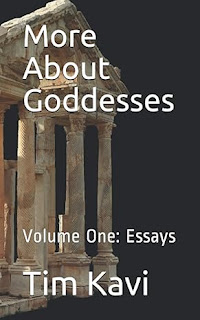
Tim Kavi announces that he is restarting his popular "More About Goddesses" column, this week on June 6th or 7th, 2025 with a column about the Buddhist Goddess, Marici. Please stop  by this blog for a read. Meanwhile, you can check out the other (very popular MAG columns) here on this blog, by doing a search in the upper right search box with the terms: "more about goddesses" or check out the book linked below for some of my past columns and a few new ones that aren't on the blog. Thanks for reading, and for your support!  Namaste ~~TK


Buy thi book to support Tim Kavi's Work


Sunday, October 17, 2021

Rising Goddess in the Night (new poem)


Rising Goddess in the Night

by Tim Kavi


across the majestic sands of time

arises a crescendo of light

from the sounds of crashing waves

the dark moon shines


the horsemen ride

leaving tracks in the sand

to be washed away

like forgotten memories


I thought I saw Her face

there before, She is met

By Herself, there was eternity

in her breath


there is only the longtime

sculpted, across all the faces

of every goddess

there is a reckoning


a sure awakening 

of her might

for she rides in

on the tide


the rising goddess 

in the night.  

Monday, May 13, 2019

Prices on Kavi Collections Have Been Dropped for a Limited Time!


Hello readers of this blog and my work:

The prices on all three of my collections have been reduced at Amazon. This means you can pick up all the eBooks! Lost Love Poems for 1.99, and Emerging Goddess and Ascending Goddess for only 2.99 each. (USD funds). If you've ever been blessed, helped, pleasantly provoked, or would like to otherwise show some appreciation for my work, please stop by this link. Please support the work of this writer as he works his way through poetry school! Thanks! ~~TK

Tuesday, August 13, 2013

More About Goddesses: Nike, the Greek Goddess of Victory


More About Goddesses: Nike, The Greek Goddess of Victory
by Tim Kavi
This goddess may be referred to as the winged goddess Victory or Nike in the Greek tradition, or as Victoria in Roman legends. She personifies victory, speed and strength and acts as one of the dominant deities of the panthenon. Victory is also commonly shown as the goddess which oversees battle or peaceful competition. She is commonly shown on Greek coins and artwork that often depicts her with her hand outstretched toward the statue of Athena within the Parthenon. She may be shown with a palm branch, torch or sash, and will frequently wear golden sandals.

In most cases she is depicted with wings and as a close companion to Zeus and Athena. Her wings are typically considered to be those of a swan, though some depictions also show her with eagle wings as Victory was known to tend to eagles. In some cases she is shown with a staff, wreath of victory or riding in her chariot. Nike has no spouse or children. She is always depicted as being quite fit, and tends to be noted for her skills as a charioteer, and swiftness when in flight or running. In some cases she is considered to help with courting, love or childbirth.

Nike was born of Styx and the titan Pallas, though some legends refer to her father as Ares, the God of War. She is the sister of Zelus, Bia and Kratos which represent, zeal, force and strength respectively. Legend has it that Styx brought Nike to Zeus when Zeus was calling for allies to fight in the Titan War, in spite of the fact that Nike was in fact half Titan. She is most commonly depicted as participating in the battle of Titanomachy.

During this battle Victory flew across the battlefields, rewarding any responsible for victory with fame and glory. This is also considered to be her weakness as Nike is rather inconsistent about awarding victory to those who worship her. She was appointed to be the charioteer with her siblings acting as sentinels by the throne of the gods. Aside from such legends, Victory does not have much mythology to call her own.
Sites of Worship and Statues
One of the most well-known statues of Nike was located on the island of Aegean in Greece. This statue is known as Nike of Samothrace, which is now held in the Louvre in Paris. She is also shown many times in the Acropolis in Athens. While the Parthenon in this area is dedicated to Athena who provides skill and wisdom during war, there are many references to Nike here as these goddesses are considered to be close friends. Nike is considered to preside over the temple of the acropolis in Megara.
Victory’s Role Today

Victory or Nike is often depicted on logos and awards including Nike, Inc., the Victory Metal from World War II and the Rolls-Royce logo. But perhaps she is most important to women. She represents a strong female character that ever faithful to her friends, who was both capable of standing alongside her counterparts and rewarding their actions which she finds favorable.

This essay (along with others) is included in my latest essay collection: More About Goddesses! (which you can purchase in the left margin of this blog!)`--TK

Wednesday, June 12, 2013

More About Goddesses: Minerva, the Roman Goddess of the Arts


More About Goddesses: Minerva, the Roman Goddess of the Arts by Sir William Smith (Guest Blog Post)

Minerva is called Athena by the Greeks. The Greek goddess is spoken of in a separate article. [Athena]. Minerva was one of the great Roman divinities. Her name seems to be of the same root as mens; and she is accordingly the thinking, calculating, and inventive power personified. Jupiter was the 1st, Juno the 2nd, and Minerva the 3rd in the number of the Capitoline divinities. Tarquin, the son of Demaratus, was believed to have united the 3 divinities in one common temple, and hence, when repasts were prepared for the gods, these 3 always went together.

The Later CapitoLine Dieties:
Juno, Jupiter and Minerva

She was the daughter of Jupiter, and is said to have sometimes wielded the thunderbolts of her father. As Minerva was a virgin divinity, and her father the supreme god, the Romans easily identified her with the Greek Athena, and accordingly all the attributes of Athena were gradually transferred to the Roman Minerva. But we confine ourselves at present to those which were peculiar to the Roman goddess.

Being a maiden goddess, her sacrifices consisted of calves which had not home the yoke. She is said to have invented numbers; and it is added that the law respecting the driving in of the annual nail was for this reason attached to the temple of Minerva. She was worshipped as the patroness of all the arts and trades, and at her festival she was particularly invoked by all who desired to distinguish themselves in any art or craft, such as painting, poetry, the art of teaching, medicine, dyeing, weaving, and the like. This character of the goddess may be perceived also from the proverbs to do a thing skillfully even mindlessly, i. e. to do a thing in an awkward or clumsy manner; and with Minerva's blessing even the efforts of a stupid person may be they who (are) presumed to set right an intelligent one.


Minerva, however, was the patroness, not only of females, on whom she conferred skill in sewing, spinning, weaving, but she also guided men in the dangers of war, where victory is gained by cunning, prudence, courage, and perseverance. Often she was represented with a helmet, shield, and a coat of mail; and the booty made in war was frequently dedicated to her. Minerva was further believed to be the inventor of musical instruments, especially wind instruments, the use of which was very important in religious worship, and which were accordingly subjected to a sort of purification every year on the last day of the festival of Minerva. This festival lasted 5 days, from the 19th to the 23rd of March, and was called QuintArius, because it began on the 5th day after the ides of the month. This number of days was not accidental, for we are told that the number 5 was sacred to Minerva,

Tuesday, May 21, 2013

From glory to Glory (New Poem)

"Lady of the Sea" artwork by Jonathon Earl Bowser


From glory to Glory
by Tim Kavi

there is only
the calling that is
that arises
as sure as any dawning
certain in the uncertainty
that any hope
of tomorrow always brings

the promise of an appearing
to live again!
a stream is ongoing
You cannot step into the same river
twice; Heraclitus said

well spoken
to remember; I am not the same
the river has a name
but it is not the same river

never give up hope
in the wading to a deeper place
in the swimming in a deeper love
in a kiss from galactic orbs
of being

enter the stream
cross the stream
bridge it in Divine love
walk on water in human love
the stream where the bowl
swirls backwards
showing proof of that which is
manifested

in the bridge
of person to person
to the waters of healing
to the tears that feed the stream
to the stream that becomes
a river of self acceptance
self love transcended then to Other love

the basic walk of toddlers
in a mature universe taught by love
until riding the waves
goes to the stream
babies to the river
we are baptized

so that love
teaches it 
becomes an ocean
where we never lose who we are

for who I am is a who WE are

swim on
walk to the side
make way for the journeying
break it up
turn again; find anew
when you come again to the banks
of existing

hope; a reflection in the water
Goddess we are seeing Saraswati
in the water

Shekinah glory
led from glory to glory
the Other side of your godly form
I no longer see my masculine face
washed in your water

I cannot stand in Your temple
I no longer see war and hate

it morphs again
and again
I look again my aged masculine face
renewed by your love

in your Youth I am cleansed
the stream is calling entry
the river is flowing
the ocean nearly overcomes

therein the waters of existence
Shekinah, I am brought 
guided again, to your dove like love
even to Your Goddess face.

Tuesday, May 14, 2013

More About Goddesses: The Greek Goddess Hera


More about Goddesses: The Greek Goddess Hera
by Tim Kavi

Hera acts as the reigning queen of the gods in Greek mythology due to her role as Zeus’s wife. (Her counterpart is the Roman Goddess Juno). Hera also acts as the goddess of marriage and childbirth. Because Zeus is also the god of philanderers, their natures would frequently clash. This has led to Hera being depicted as a quarrelsome and jealous goddess that can be a force to be reckoned with. In spite of her place as Zeus’s bride, the worship of Hera is actually much older than that of her husband, stemming back to the days when the Greeks believed that any single entity associated with divinity must take the form of a woman. Her role is believed to have changed when the male’s role in procreation became more understood, leading to Hera’s worship as a mother figure rather than an all-encompassing deity.

Much of Hera’s jealousy was directed toward women that Zeus seduced or had affairs with, though one of the most common legends associated with Hera is her jealousy toward the hero Hercules. This jealousy stemmed from the fact that Zeus fathered Hercules with the mortal Alcmene, a mortal. Hera went as far as to send snakes to kill Hercules when he was a baby. She also stirred the Amazons against him while he was on a quest.

Another famous legend associated with Hera has to do with the judgment of Paris. At the wedding between Peleus and Thetis (the later parents of Achilles) many gods and goddesses were invited to the ceremony. Eris, the goddess of discord, threw a golden apple among some of the goddesses, and only the fairest was to own the apple. Since Hera, Athena, and Aphrodite claimed to be the most beautiful goddess, a decision had to be made as to which goddess should own the apple. The goddesses brought the question before Zeus, but Zeus was wise enough to leave the choice of who was the most beautiful up to Paris, a Trojan prince. So the three Goddesses, Hera, Athena, and Aphrodite came before Paris, but he could not decide. Finally, each of them offered Paris a gift to try to persuade him. It is said that Athena offered him great fame and glory in battle, Hera offered him control over all of Asia and Europe, and Aphrodite offered him the most beautiful mortal woman in the world. Because of this he chose Aphrodite, which absolutely enraged the other two goddesses, especially Hera. Of course, the most beautiful woman in the world at that time was Helen of Troy who was already married to the King of Sparta. So after the abduction of Helen by Paris, there was a great war (partially stirred up by the jealous goddesses); and this was called the Trojan war.

There is some debate surrounding Hera’s familial roles. Some origin stories depict Hera’s parents as the Titans Rhea and Cronos, making her Zeus’s sister. Given these close family ties, there is some debate on whether or not Zeus and Hera produced children together. Hera is known as the lone parent of Hephaestus. Ares and Hebe are often depicted as the children of Zeus and Hera, but in some traditions Ares is seen to have been conceived from a flower in the field of Olenus and Hebe fathered by a lettuce. These tales may have been invented to avoid adding scandal to Hera’s myth.

In any regard, the Greek goddess Hera is a major part of goddess mythologies and motifs. She is not only a fierce mother image, but also that of the fierce, powerful wife, and symbolizes both a wifely devotion towards her husband, and respect for the protection of marriage.

Sunday, April 28, 2013

Vows (new poem)


Vows (new poem)
by Tim Kavi


some say things
in the heat of passion
or the throes of love
but in the gentle promises
of an everyday love
my vows to you, Goddess
are not broken

I may weep for a night
wail for a season
toss ashes on my head
lie unshaven in sickness
fasting until weak in body
strong in spirit

Yet your voice does not stop
calling me to a deeper place
one that does not judge
or reproach me
except for righteous seeing
and a knowing every thing

some think that only a male (deity)
can see everywhere at once
but there is only a knowing
in your power of self assured
place; the movement of a Goddess
in grace; that some imagine

should not always be
mistaken for the benevolent
mother; but instead are
the callings of one
who seeks to gather in strong
voice; the vows are not weak

so calling, turning
and yearning the shackles enduring
to drop off my hands and feet
turned like phantom keys at once
in the burning
candlelight vows of silence

I read your words
in the light but must wait the
appearing of Furies
to turn the pages in windy visitation
such coolness are your words
modern leaders should take heed

for in the Suvarṇaprabhāsa-sūtra
सुवर्णप्रभासोत्तमसूत्रेन्द्रराज; Sutra of the Golden Light
I need the protection
of Sarasvati, Lakshmi, and Drdha
Earth goddess--please save us from night!
For there is only in the dawning

the candle light
has burned out; but the new day
has come. I speak my vows
with renewed fervor
your voice is still speaking
I must utter this poem

Dear sweet Goddess
lead us home
to your love; and a turning
to each other; be not angry
in my responsbility
my vows must not be broken

to turn to You
with an open heart
to serve others
to help and to heal
to speak a word of kindness
while walking with the Dharma wheel

for I would rather
have a vow of love for my fellow
man and woman
than any vow of disgrace
revenge or hate

for it is the vows
you brought me
when I as a chained one
was never free
but now I walk out of here
at full liberty

and on the distant hill
the lights of home
call me back
to the place I ever will
remain in your love
it is only a graceful meeting

of the vows
of turning to each other
met there
in the words of constant revealing
what is truly between
you and me
in your daily appearing.

Poet's Afterword: Perhaps you are curious about the Golden Light Sutra, a sutra that if read aloud can bring peace in the midst of a violent world, and if believed just a little--could bring great benefit. Here is a link to downloads of the Golden Light Sutra . Also, you can click here to read a article about the benefits of this Mahayana Buddhist text. The sutra, as well as this poem makes reference to several goddesses, notably, Sarasvati (Saraswati) aka Benzaiten. Saraswati, a manifestation of Maa Durga, and re-personified as Benzaiten is an important goddess in both Hinduism and Buddhism. The Asian letters; characters that when written, represent Benzaiten, implies a Goddess that is skillful at discourse (among many other attributes), hence the poem ends with an encounter with the Goddess in "words of constant revealing". The Sutra itself, is highly regarded as an important work in Mahayana Buddhism. ~~TK

Monday, March 18, 2013

Publication News: Ascending Goddess Goes Even More International; Spain Bookseller Casa Del Libro Recognizes the Book's Feminist Message

Ascending Goddess is going more and more international with even more booksellers picking it up in Europe, Germany, Japan, Spain, Canada and the UK! For example, in Spain, Ascending Goddess by Tim Kavi and TiLu Press are deeply honored that the title is being packaged with Jean Shinoda-Bolen's Urgent Message from Mother: Gather the Women, Save the World as a joint purchase. Author Tim Kavi was strongly influenced by Dr. Shinoda-Bolen's books and message, especially Goddesses in Every Woman, and his own teacher's book The Goddess by Dr. Christine Downing. While we are very honored that booksellers are seeing the connection between Ascending Goddess and other works that emphasize the Sacred Feminine and the need for the empowerment of women; we are also humbled by the sacred responsibility of sharing the message that there is a better way for the world than unbridled male aggression. Mistreatment of women must stop and respect for the leadership and compassion of women must be honored. (Note this is not to imply any endorsement by the aforementioned authors for Ascending Goddess, merely that Tim Kavi is humbly honored by the recognition).--From TiLu Press, Tim Kavi's Publisher

Updated: You too, can own any of these Goddess books referred to, by clicking on their images below:


Saturday, March 16, 2013

More About Goddesses: Bast (Bastet)


More about Goddesses: The Egyptian Goddess Bast 
by Tim Kavi

Bast is an influential goddess in Egyptian mythology, representing sensual pleasure. Bast also acts as the guardian saint of firefighters, protector of the household and a bringer of wealth. Bast may also be known as Basthet or Bastet and is widely represented as the cat goddess. Due to her role in protecting Ra, her father, from his enemies, she has also taken on the role of the All-Seeing Eye. This is occasionally represented as the Goddess of the Rising Sun or Lady of the East.

Bast is one of the most ancient goddesses, she is depicted in many versions of Egyptian art. She is frequently depicted as a beautiful, slender woman with the head of a cat. The grounds of her temple hold a large cat cemetery where her companions could be mummified or entombed to join her in the spirit world. Cats are frequently honored at her temple, many taking up permanent residence. These cats were known to run into local homes when they caught fire, leading the residents to safety, which led to Bast’s association with fire-fighting and protection of the home. Some say that cats that lost their lives in this undertaking could be brought back to life by Bast’s power, which may be the source of the belief that cats have multiple lives.

During the day, Ra would fly through the sky, using his boat to pull the sun through the sky. When darkness falls Bast transforms into a cat, taking advantage of the creature’s superior night vision to watch for Apep, a serpent that acts as Ra’s greatest enemy. Legend has it that Bast was able to kill the serpent when the priests of Ra failed to hex him with the sacred wax models. Due to this dual nature of her story, Bast is one of few sun goddesses that is also known as a moon goddess. Her sacred all-seeing eye reflects the light of the moon, protecting her followers from enemies in the darkness.

Thursday, January 24, 2013

The Table in the Wilderness (new poem)


The Table in the Wilderness
by Tim Kavi

the table
in the wilderness
where the Goddess
and I broke bread

lies broken
in the aftermath
of history

many have returned here
they look for you
and cannot find you

but You do not
come to every place
only because You
are within

you are every place
already
where we are
where we go


If only they knew it
would call upon you
O Goddess
in the disorder
Concordia
is the present one

bring me peace
as the ravens feed
the wild eyed ones

eyes darting
only you can cure
the madness
in the return

dear departed
Goddess
return again

found in the heart
always there
in a gentle touch
a loving stare

a hand that reaches
to the bowed down
that says to the lowest
come up hither
to higher ground

I see a table
spread with the finest
delights
the greatest silk linen

the most beautiful of all
thank you for being
here again

in this wilderness
of existence
found again

there are the singing ones
loosed in tongue
there are the dancing ones
loosed in leaps
like gazelles
stepping between mountainous rocks

a flower springs
in the desert
where did it thirst?
how did it drink?

I see You
every time
a manifestation
in our love

hasten
hasten
hold us again
we are waiting

at the table
in the wilderness
of Your love.

Wednesday, January 9, 2013

More About Goddesses: Isis


More About Goddesses: Isis
by Tim Kavi

Isis is the Egyptian patron saint of magic and nature. Isis appears as protector of children and a protector of the dead. She is commonly depicted as being a friend to artists, sinners, slaves and the downtrodden, though she would also listen to the prayers of rulers, aristocrats, the wealthy and maidens.

Isis is the mother of Horus, the god of protection and war. Her name literally translates to “throne” and she wears a throne on her head to depict this, though it is believed that she was seen as a wife or assistant to deceased pharaohs in the Old Kingdom. She acts as a symbol of the power of the pharaoh, and the current pharaoh would frequently be depicted as her child, sitting on her throne. The myth of Isis became exceptionally popular in the Greco-Roman period, though the image of Isis mothering the leader of the Egyptian world was translated to an image of Mary suckling her son Jesus as the Christians moved to suppress “pagan” religions.

Temples to Isis were built throughout Rome, Iraq and Greece, though it was understood that Isis remained with her husband Osiris in Egypt. These temples would become home to healers believed to have special powers to control the weather or interpret dreams which was accessed by braiding the hair in a special way. The cult of Isis widely believed that knots held special power which could be accessed by adorning your body with them. Very little about the rituals of the Isis cult is known because they were disbanded during the Greco-Roman area.

It was frequently believed that her tears would cause the Nile River to flood. Isis would weep for the death of Osiris as he died and would become reborn each year, contributing to the flooding cycle that occurred each spring. Her cult remained quite local to this area, even after Egyptian mythology proceeded to spread to further reaches of the kingdom. Egypt is seen as her home, though she would see leaders on to the afterlife in some depictions. Isis is considered the mother of the four sons of Horus, the deities in charge of protecting the canopic jars which held a pharaoh’s internal organs after death. Isis was especially associated with Imesty, the protector of the liver jar.

In the New Kingdom, the role of Isis evolved as the cult of Ra rose in prominence. Ra was paired with Horus, and since Isis was paired with Horus, she rose in prominence throughout the ancient world. During this time, the myth of Isis and Osiris became one of the most important myths in Egyptian culture. Set murdered his brother Osiris in order to usurp the throne. Osiris’s wife Isis, brokenhearted, restored her husband’s body so she could conceive a son with him posthumously. This son was Horus, who would frequently battle Set for the throne, a battle which eventually became victorious. As Horus became the protector and representation of the pharaoh, Isis became the protector of the pharaoh who would see him to victory in his endeavors.


Saturday, January 5, 2013

Tim Kavi Starts New Year with Latest Publication


My Latest Publication
by Tim Kavi

Hello, All!  First of all, a very Happy New Year to each and every one of you!  I hope that your New Year brings you health, prosperity, and happiness!

My New Year began less conspicuously than I imagined with the publication of Athena: Queen of the Air by John Ruskin, on January 1,2013 from TiLu Press. This work, an updated and annotated version from an 1869 work, includes new material for modern readers who are interested in Greek mythology, mythology, or Goddess themes and motifs.  In particular, the book talks about the Goddess Athena in great detail.  My essay about Athena is one of the three forewords in the 2013 edition of this book. I am honored by the inclusion.

My essay: 'Athena: Greek Goddess of Wisdom and War' was one of my blog entries here last May. You can click here to read it.  I suppose this amounts to a disclosure, as my foreword (only one of three in the book) is reprinted with my permission for the book. I assure you that there is much more in this book that makes it worthwhile to read if you are a fan of goddesses, Greek Art and Mythology, mythology, and art criticism in general.  I really hope readers of both works (my blog and the book) don't mind this fact that my Foreword is published in both places.  To me, it is simply about getting the message out to as many readers as possible.

I enjoyed reading this eBook, and if you're interested in Goddesses too, I think you'll enjoy it just like I did! I certainly learned a lot about Athena that I never knew before!  The book also contains an introduction that covers much background about John Ruskin, Athena, Ruskin's Athena and information about the 2013 edition.  Other new annotated material (never before published anywhere) includes an original essay on Athena by Kelli M. Webert titled: 'Athena: Queen of the Air and Breath of Inspiration' and finally, a chapter titled:  'A Brief Literary Biography of John Ruskin'.

Overall, the book 'Athena: Queen of the Air' is an interesting work of Greek Mythology and art criticism that discusses the Goddess Athena in great detail. I hope you will enjoy it!

From the Book Blurb:

"Very thorough, and inspiring, Ruskin, ever the Victorian Age's greatest art critic, utters praise to Athena, and in doing so, speaks some of the most poetic words ever used in English to describe the goddess."--Tim Kavi, Poet

"And so the Spirit of the Air is put into, and upon, this created form; and it becomes, through twenty centuries, the symbol of divine help, descending, as the Fire, to speak, but as the Dove, to bless."---John Ruskin

Currently Available as a Kindle and Kindle Apps Edition--by clicking here.

THANKS! ~~TK


Wednesday, December 19, 2012

More About Goddesses: Ma Durga (Mahadevi), Warrior Goddess of the Hindu Tradition


More About Goddesses: Ma Durga
By Tim Kavi

Ma Durga, or the Durga mother, is the fierce form of the goddess Devi in the Hindu tradition. She is often associated with Mahadevi, the supreme goddess for her defeat of Mahishasura Mardini the buffalo demon. Ma Durga is frequently portrayed with multiple arms, which can be as many as eighteen in some interpretations. She is also frequently portrayed riding a tiger or lion or using weapons to slay demons as a show of her power. Many portraits relate the story of her victory over Mardini, showing her slaying him or holding off his forces as they attack.

The legend of Ma Durga first appears on the narrative of Devi Mahatmya within the text of the Markandeya Purana. According to legend, Ma Durga was created in the image of a warrior goddess to help fight the asura Mashishasura. The warrior gods were ineffective against this demon because Brahma had blessed Mashishasura with the power to be undefeatable at the hands of man or god. To counteract this magic, Shiva requested that his wife Parvati take on a role where she could take on this demon. While she called upon the priests at Vaikuntha, Shiva tried to hold off Mashishasura and his forces by combining the three lead gods and emitting a beam of light.

Though the gods were defeated, this light reached Parvati at Vaikuntha, alerting the gods here. To save the three worlds, they combined forces to create a new pool of light. From this light rose Ma Durga, the female aspect of Brahman, a lila that emerged from their combined energy and compassion.

As she moved forward to battle Mashishasur, he made the mistake of underestimating her power, thinking that a woman could not possibly defeat him after he had defeated a trinity of gods. To show his strength, he changed forms many times as he rampaged toward Ma Durga, appearing as a buffalo demon, an elephant, a lion and a man. Ma Durga is said to have gracefully defeated each of these forms. In his last charge, Mashishasur returned to his buffalo form, but became trapped between this and the form of a man. Laughing at his predicament, Ma Durga cut him down with her sword, ending the battle and cementing her compassion in the hearts of her followers.

According to some versions of the legend, Ma Durga raised an army to march against Mahishasur as he terrorized heaven and earth. This battle raged on for ten days before she took it upon herself to slay this demon king. As a reward for their good service, Ma Durga rewarded her troops with the knowledge for jewelry-making. Because of this gift, Ma Durga is frequently depicted in art pieces. She is often represented covered in stones and jewels, even in scenes that act out the tale of her decapitating the buffalo demon. This act of bravery and compassion is also worshiped widely in many parts of the Himalayan region and throughout India, especially during the ten day period when the battle was said to have commenced.

Poet's Afterword: The Hindu Goddess Ma Durga is in a number of my poems, and in a couple of blog entries here, she makes major appearances.  A related blog entry on Parvati is here. In one of Ma Durga's manifestations she is quite the warrior goddess (Mahadevi), which seems pertinent to mention, as this is also a theme in other More About Goddess columns that have featured Artemis and Athena  from the Greek tradition. ~~TK  P.S.--I love this song about Ma Durga on my YouTube Page by Krishna Das (I've seen it performed live!). Hope you enjoy!!~~TK


Wednesday, April 18, 2012

More About Goddesses: Parvati, Goddess of Love and Devotion (Essay)


Parvati, Goddess of Love and Devotion
by Tim Kavi

Also known as the daughter of the mountain, the goddess Parvati’s story might indeed be one of the most interesting of goddesses. She was born out of need as the gods need the assistance of the God Shiva. Shiva, however, had holed himself up in a mountain cave of the Himalayas, doing nothing but meditating and performing tapas to mourn the loss of his first love. His heat and energy grew and grew, and he became full of knowledge.

So the goddess Shakti went into his cave, some stories say appearing as a serpent and coiled herself around Shiva to draw out his energy and power so he would father a child, as the gods knew that only a child born of Shiva would be powerful enough to help them. Shakti than birthed herself into the goddess Parvati and her main goal was to win Shiva’s affections.

Even as a child she was deeply in love with him and went to his cave every day to sweep and decorate it with flowers. Shiva, however, never once noticed her, and could not be brought out of his mediations. So she invoked the help of Priti and Rati, who changed the cave into a thing of beauty, and then brought the lord of desire, Kama, to Shiva, but Shiva destroyed him by shooting flames from his third eye.

Having lost the lord of desire, the gods were hopeless of what to do with Shiva. Parvati then took off to go to the woods with nothing, not even clothing, to meditate and learn tapas, until her strength grew to that of Shiva’s and he took notice of her finally and took her as his wife, which also restored Kama back to life.

Other Tim Kavi Content About Parvati: Parvati is mentioned on my blog in at least two additional places. In my poem: Goddess of the Lake and another 'More About Goddesses' Column about Durga Mahadevi .  Enjoy! ~~TK

Sunday, June 6, 2010

the morphing (poem)


the morphing

by Tim Kavi

changeling of the true

(YOU are other
different than what I thought
with even greater beauty
that you yourself has brought).

rebirthing
human potential
repairing
the previous ways
made rent

every soul transcending
bending
rescinding
rending

overturning
there is a churning
burning
destruction falls into the sand
erodes into the sea

previous selves
become forgotten selves
or instruments of
lessons divine
in some eternal shrine
and design

until there
is an emerging
chrysalis
from the fiery ovens
and ash

She stands
girded in the new
emerging in my soul
triumphant
anima and goddess

I see you morphing
into every Goddess
a thousand times
a thousand times
from the moment
of creation
conception
to ultimate development
I see her inside you
and she is You

standing there
looking back
through your eyes
companion and mother
sister
and ultimately, wife

(YOU are other
different than what I thought
with even greater beauty
that you yourself has brought).

Friday, April 17, 2009

Near the Rhododendron (Poem with Poet's Comments)


Near the Rhododendron
by Tim Kavi

when in
the silent branches
of beautiful
rhododendron
the sun rose

morning dew
drops
clung to
your branches

Nature's
smile
was at
your morning
beauty

Yet the branches
supported
the beautiful
flowers

Nature had
prepared
you
for a wonder
of unveiling

planted firmly
in the soul
your roots
dug deep

living
and breathing
creeping
and revealing

You were
as pretty
as She

lying there
on the blanket
in the Golden
Sun

Nature clung  
to You, Goddess
the best
planting

ever seen.

Poet's comments:
This is another devotional poem on my recurrent theme of the Goddess (woman, femininity) in Nature. Here, we are once again reminded that as much as Nature takes care of a beautiful flowering plant, supports it, and it thrives in great beauty, so it is with eternal woman. In the end She is the best planting, more beautiful, and embraced by and clung to by Nature itself. I often use definitive terms in my poetry through the use of capitalization, for example whenever I capitalize 'You' I am referring to an encounter with an otherness, that is so special, so unique, it is an address and response to a particular person, wherever that Goddess nature is so revealed. It is the You of You and Me or I and Thou once again. It is the You encountered in dialogue and full revealing at the moment of encounter. This is the moment of revelation, a perception of the dawning of the day, a day where the sun shines and lights up the beautiful rhododendron, but as powerfully, a day of a woman's revealing.--T.K.


Addendum:  This poem, which is one of my most popular poems by blog visits, has been included in my collection, Ascending Goddess which means you can own it for your very own Kindle edition by clicking here ! (Reprinted on this blog by permission of my publisher TiLu Press, LLC) Thanks ~~TK