Showing posts with label More About Goddesses. Show all posts

Thursday, January 29, 2026

More About Goddesses: Juno: Queen of the Roman Gods and the Archetype of Sovereign Womanhood (New Essay)


More About Goddesses: Juno, Queen of the Roman Gods and the Archetype of Sovereign Womanhood (New Essay).

by Tim Kavi

Among the deities of ancient Rome, few held as much authority, complexity, and symbolic power as the goddess Juno. Revered as queen of the gods and protector of the Roman state, Juno occupied a central role in Roman religion for centuries. More than merely the wife of Jupiter, she embodied ideals of sovereignty, feminine strength, marital commitment, and civic responsibility. Through her history, mythology, and enduring archetypal meaning, Juno offers timeless instruction about power, identity, and the sacred nature of relationship.

Juno’s origins stretch back to early Italic religion, where she was likely worshipped as a guardian spirit of women long before Greek influence shaped Roman mythology. Her name is linked to the Latin iuvenis, meaning “youth,” suggesting her role as a life-giving force. Over time, she became identified with the Greek goddess Hera, inheriting many of her stories while retaining distinctly Roman characteristics. As part of the Capitoline Triad (sorry, this reference is not to be confused with the usage in a well known video game ;-) )—alongside Jupiter and Minerva—Juno stood at the heart of Roman public worship, symbolizing the stability and continuity of the empire itself.

Mythologically, Juno is best known as the wife of Jupiter, whose numerous infidelities fueled many dramatic tales. Her anger toward Jupiter’s lovers and offspring—such as Io, Semele, and Hercules—has often been misunderstood as petty jealousy. In Roman thought, however, her wrath represented the defense of sacred order. Juno was not merely reacting emotionally; she was guarding the sanctity of marriage, lineage, and social contracts that held civilization together. In this sense, her conflicts reveal the tension between unchecked power and lawful authority.

Juno’s many titles reflect the breadth of her influence. As Juno Regina, she ruled as queen of heaven. As Juno Lucina, she presided over childbirth and the light of new life. As Juno Moneta, whose temple housed Rome’s mint, she became a guardian of memory, warning, and economic stability—the origin of the word money. Each aspect reveals a goddess deeply woven into both private and public life, from the intimacy of birth to the governance of the state.

As an archetype, Juno represents sovereign womanhood—the capacity to know one’s worth and to demand respect within relationship. She teaches that partnership must be reciprocal, not diminished by imbalance or betrayal. Juno does not surrender her authority even when wounded; she remains queen. Her mythology reminds us that dignity is not passive but actively maintained.

Psychologically and spiritually, Juno instructs us about boundaries, commitment, and the cost of remaining silent in unjust arrangements. She embodies the voice that refuses erasure, the insistence that loyalty must flow in both directions. While her myths depict rage and vengeance, these emotions point to deeper truths: anger can be a signal of violated values, and confrontation may be necessary for restoration of order.

In the modern world, Juno endures as a powerful archetype of self-respect and moral authority. She reminds us that love without equality corrodes, that institutions require accountability, and that true partnership—whether in marriage, governance, or personal identity—demands honor. As queen of the Roman gods, Juno stands not merely as a mythic figure of the past, but as a lasting symbol of strength, conscience, and sovereign presence.

Wednesday, July 9, 2025

More About Goddesses: The Afro-Brazilian Goddess Yemanjá: Queen of the Ocean. (New Essay)


MORE ABOUT GODDESSES: The Afro-Brazilian Goddess Yemanjá: Queen of the Ocean. (New Essay)

by Tim Kavi

Yemanjá, also known as Lemanjá, revered Afro-Brazilian goddess in Candomblé and Umbanda, embodies the profound power and mystery of the ocean. Celebrated as a nurturing mother, fierce protector, and source of life, her immense presence in Brazilian culture is undeniable. Her story, rich with transatlantic history and spiritual evolution, positions her not only as a divine entity but also as a powerful archetype reflecting universal human experiences.

Yemanjá originated in West Africa's Yoruba traditions as Yemọja, a powerful river deity of the Ogun River and mother of all orixás. When enslaved Africans arrived in Brazil, they carried their spiritual traditions. As the Atlantic Ocean became a symbol of the terrifying journey and new home, Yemoja's domain shifted from river to sea, transforming into Yemanjá. This syncretism linked her with Catholic figures like Our Lady of the Immaculate Conception or Our Lady of Navigators, ensuring her worship endured under the guise of the dominant religion.

As Queen of the Ocean, Yemanjá is typically depicted with flowing blue or white garments, adorned with pearls, shells, and marine treasures. She has also been seen as a mermaid. Her symbolism is rich: mother of all, source of life, fertility, and abundance. She governs literal waters and humanity's emotional depths. Devotees turn to her for protection, particularly for sailors and fishermen, for guidance in family and motherhood, and for cleansing and purification. Her gentle yet formidable nature represents the ocean itself – calm and nurturing one moment, tempestuous and unyielding the next. She epitomizes unconditional love, patience, and ancient aquatic wisdom.

Yemanjá's worship is vibrant and public, especially in Brazil's coastal cities. On New Year's Eve (December 31st) and February 2nd, millions gather by the sea to honor her. Offerings of white flowers, perfumes, candles, and small gifts are cast into the waves, accompanied by prayers for blessings, health, and prosperity for the coming year. These communal rituals reinforce the deep connection between people, ocean, and her divine feminine power.

Beyond deity, Yemanjá functions as a powerful Jungian archetype, representing universal psychic patterns. Features of said archetype:

The Great Mother Archetype: She embodies the ultimate nurturing, protective, and life-giving force. Like the ocean, she is the primordial source from which all life springs, offering unconditional love and sustenance. This resonates with the human need for a secure, benevolent origin.

The Collective Unconscious: The vast, unfathomable depths of the ocean mirror the collective unconscious – the repository of shared human experiences, instincts, and universal symbols. Yemanjá, as its ruler, offers access to deep wisdom, intuition, and the primordial self.

Transformation and Rebirth: The ocean's constant ebb and flow, its capacity to cleanse and renew, reflects psychological transformation. Yemanjá aids in shedding the old and embracing new beginnings, symbolizing emotional purification and spiritual rebirth.

Resilience and Adaptation: Her transformation from river goddess to ocean deity, and syncretism with Catholic saints, exemplifies cultural resilience and the adaptive power of belief systems in the face of adversity. This echoes human capacity to adapt and find meaning in challenges.

Yemanjá, Queen of the Sea, is more than myth; she is a living symbol of maternity, strength, and life's enduring power. Her journey from Africa's rivers to Brazil's oceans encapsulates a profound history of survival and adaptation. As an archetype, she continues to provide comfort, inspiration, and a deep connection to nature's primal forces and the human spirit, reminding us of our origins and the boundless capacity for renewal.~~TK

Thursday, July 3, 2025

Publication Announcement: "'More About Goddesses" Column To Feature Wider Scope

 Dear Readers:

As I've mentioned before, one of the most visited features on this blog has been quite popular with readers from all over the world. Lately, this has been especially true with my "More About Goddesses" columns, which feature summaries about various Goddesses from all sorts of traditions. I will be broadening the scope, to include many more  Goddesses, beyond the main ones typically thought of, and from various systems of thought. As such, I am especially moving into columns about Buddhist Goddesses, and soon will be including more Goddesses from Brazilian and other South American cultural influences. I will not neglect the others either, so don't worry, bringing in a good mix that I hope you will enjoy.  Remember, I strive to share about Goddesses so that we can understand them archetypally, learn something (both you and I) from their stories, deeds, and powers to make some changes in our lives and the world for better.  And ultimately, to eat away at the misuse and abuse of patriarchy,

In light of this, my next columns will continue to feature new Goddesses with my new emphasis, with an Afro-Brazilian Goddess named. Lemanjá, also known as Yemanjá, or Yemoja. That column should be posted here on this blog, Kup of Kavi next week. Happy reading and thanks for your support and prayers, so I can continue to write and share with you my heart. For it is a heart filled with wonder and love and thankfulness to be here, in this time, and to share together the path towards wholeness and meaning, and to be part of each other in the world. In dialogue, I am Tim Kavi. ~~TK

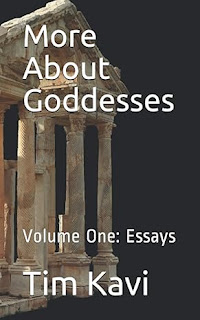
My previous columns and some not on the blog are in this book:

(You can click on the cover image, to get a copy for your very own).


Tuesday, June 3, 2025

Blog Publication Announcement: Return of Popular 'More About Goddesses Column'. (News)


Blog Publication Announcement: Return of Popular 'More About Goddesses Column'. 

Tim Kavi announces that he is restarting his popular "More About Goddesses" column, this week on June 6th or 7th, 2025 with a column about the Buddhist Goddess, Marici. Please stop  by this blog for a read. Meanwhile, you can check out the other (very popular MAG columns) here on this blog, by doing a search in the upper right search box with the terms: "more about goddesses" or check out the book linked below for some of my past columns and a few new ones that aren't on the blog. Thanks for reading, and for your support!  Namaste ~~TK


Buy thi book to support Tim Kavi's Work


Tuesday, June 28, 2016

More About Goddesses:Mother Shayi Nanzhao (Photos also by Tim Kavi)


More About Goddesses:  Mother Shayi Nanzhao
by Tim Kavi

Mother Shayi Nanzhao, also known as Shayi Mu, is one of the more obscure deities or mythical figures in worldwide lore.  Her group statues can be found on Nanzhao Folk Island, depicting a legend tracing the origin of the Ailao people, who are, in turn, said to be the ancestors of the Bai ethnic group, a cornerstone of the Nanzhao kingdom of 738 to 902 AD.  These statues are among the main attractions on the island, which has become a popular tourist destination since 1999.

Shayi, Mother of Dragons

Legend tells us that Shayi was a woman who lived in the Ailao Mountain thousands of years ago.  One day, while fishing, she had touched a log that had, for some reason, made her feel strange and eventually become pregnant.  Shayi would go on to give birth to ten sons, and several years later, when the sons had become older, she had taken them to the same river where she had mysteriously become pregnant after touching the log.

Upon seeing the log, it had transformed into a dragon, who had then asked Shayi where her sons are.  This similarly strange incident had scared off the nine older boys, who had run away upon seeing the dragon.  It was only the youngest who wasn’t scared, as he instead leaped on the dragon’s back; this prompted Shayi to name the boy Jiulong, jiu meaning “back” and long meaning “sit” in the Ailao tongue.  

Despite being the youngest son, Jiulong was chosen by his brothers to rule as king, as he had been licked by his father dragon after he jumped on his back.  The ten brothers would marry the ten daughters of a family residing in Ailao Mountain’s foot, and would become the patriarchs of the Ailao people, and eventually the Bai people.

Different Twists on the Legend of Shayi Mu

There are actually several theories pertaining to the Ailao people.  At least eight of China’s minority nationalities, including the Bai, trace their roots to the Ailao people, and have their own versions of the Mother Shayi Nanzhao/Shayi Mu myth, all similar but with their share of differences.  

Literature such as Confucian scholar Liu Xiang’s The Biographies of Women also depicts small twists on the Shayi Mu legend.  According to this tome, Jian Di, mother of Shang ancestor Qi, had also become pregnant in strange circumstances, this time swallowing a multi-colored egg that a bird dropped while she was bathing.

Due to the main similarity of these myths – a woman founding a civilization – modern scholars believe these stories were created as a means to establish patriarchy from a maternal source.

Mother Shayi Nanzhao’s Symbolism in Modern Times

Many years after the legend of Mother Shayi supposedly took place, her influence remains in modern-day culture.  

As the supposed matriarch of Nanzhao rulers and mother of the Bai people, Mother Shayi is a symbol of ancient matriarchy.  Her statue on Nanzhao Folk Island is said to be representative of independence and feminine strength and determination.  And while there has been controversy regarding whether her nude statue is appropriate, her nudity is said to be more redolent of primitive culture, as opposed to being an attempt toward eroticism.  

Overall, Mother Shayi is seen in today’s times as the symbolism of the Bai’s ancient roots and a symbol of their authenticity as a culture.

ABOUT THE PHOTOS: The photo above is an original photo taken by Tim Kavi at Nanzhao Folk Island which is near modern day Dali City in Yunnan Province, China. The photo was taken by Tim Kavi during the Summer of 2012. The island also includes the statue of another female figure from the Buddhist tradition, Kwan Yin; actual photo below. All Photos Copyright 2012 by Tim Kavi.


Wednesday, January 20, 2016

More About Goddesses: The Norse Goddess, Freya (New Column)


More About Goddesses: The Norse Goddess Freya
by Tim Kavi

Freya (also commonly spelled Freyja) is the Norse goddess of love, fertility, and sexuality.  Her name is derived from the Old Norse word for “the lady.” In Norse mythology, she is a member of the Vanir deities, together with her brother Freyr (“the lord”), her father Njoror, and her mother, whose identity is unknown.  Her husband is a god named Odr, and partly due to the similarities in name (Odr and Freya, Odin and Frigg), many scholars believe that these two couples are one and the same.
Freya’s afterlife field is known as Folkvangr, and that’s where half of the soldiers killed in battle go to, with the other half going to the god Odin’s Valhalla
.
Life of the Party, and Then Some
It can be said that Freya is the “life of the party” among Norse deities, given that she represents the aforementioned love, fertility, and sexuality, and also has a love for material trappings.  One can even say that Freya is a “player” of sorts, in informal terms.  The poem Lokasenna describes how Loki had accused Freya of sleeping with all the gods, and even her own brother Freyr.  But Freya’s seeming proclivity for decadence is just one of the many facets of her personality. 

Freya as a Master of Seidr
Freya is also known as the first to introduce seidr, a form of Norse magic, to the Aesir, also introducing the art to humanity indirectly. Seidr mainly deals with changing the course of destiny, and can be used in a number of ways, including manipulating any human destiny documented in Old Norse mythology.  

Seidr practitioners are known as volvas, and in Viking times, they traveled across different towns, performing this form of magic in exchange for food, shelter, or other types of compensation.  Due to the shamanistic nature of their craft, people reacted to Freya and other volvas with ambivalence, some respecting and exalting her and others treating her with scorn.

Freya and Frigg – Are They the Same?
It has been a much-debated topic as to whether Freya and Frigg are the same goddess, or similar, yet ultimately different goddesses from each other.  Migration Period mythology (400-800 AD) suggests that Freya was Odin’s wife, while Old Norse literature points to Freya’s husband being a god named Odr, which is very close to Odin.  This similarity in name is arguably the main reason why several experts do not differentiate between Freya and Frigg, instead considering them one and the same.
Other similarities include Freya and Frigg both being accused of infidelity while their husbands were away.  Tales such as Frigg sleeping with Odin’s brothers while he was exiled from Asgard refute the belief that Frigg differed from Freya by being more chaste.  Furthermore, the poem Lokasenna clearly shows Frigg as a volva in the same way that Freya is.

Freya after Christianization
The Christianization of Scandinavia resulted in the demonization of the Old Norse gods, though Freya remained revered by people even in modern times.  This was despite her sexual nature going against the epitome of an ideal woman for Christians – a chaste virgin.  Freya was still prayed to as a fertility goddess as recently as the 19th century, specifically for the purpose of ensuring a prosperous harvest.

About the image: The image is from the painting “Freyja and the Necklace” by James Doyle Penrose (1890)

Thursday, October 1, 2015

More About Goddesses: Pachamama, Incan Goddess (New Essay)


More About Goddesses: Pachamama, Incan Goddess
by Tim Kavi 

Pachamama is the Incan goddess of the Earth and the goddess of fertility, specifically harvesting and planting.  Her name means “mother of space and time” in English.  As a deity independent from others, she is able to, on her own, sustain life on the planet for animals and plants alike.  She also presides over the Andes Mountains and has the power to cause earthquakes.  

Most artist conceptions show Pachamama as a goddess capable of ensuring a prosperous harvest for potatoes and coca leaves.  In Inca mythology, there are four cosmological Quechua principles, namely Earth, Moon, Sun, and Water, and all trace their primordial origin to Pachamama.  

A Goddess of Agriculture

One of Pachamama’s main manifestations is as the Incan goddess of agriculture.  Incans had performed daily rituals in tribute of her, with women in particular going to the fields to pray to her, occasionally sacrificing an offering of cornmeal.  The Incans compared the mountain peaks of the Andes to her breasts, the rivers to her milk, and the fields to her womb.

Beware the Wrath of Pachamama

While considered to be a good and benevolent goddess, it is believed that Pachamama can also get angry in a significant way.  If she feels that people are not honoring her like they should, she reminds them in the form of earthquakes.  She is also said to be close to the Incan gods of thunder and lightning, and can wreak havoc accordingly when she is not worshipped or thanked.  

Pachamama in Modern Times

Even in today’s modern, post-Christianity society, Pachamama is still worshipped in certain parts of the Andes, whose people see her as a “good mother” and offer a toast to her prior to meetings or special events.  Her worship day, Martes de Challa (Challa’s Tuesday), involves people sacrificing food and incense and throwing candies.  There are even some worship celebrations where yatiris, or traditional priests, follow the ancient rites and go as far as sacrificing animals such as llama fetuses and guinea pigs.  This celebration takes place at the same time as Carnevale and Mardi Gras in other parts of the world.

In August, worship to Pachamama reaches fever pitch, as this is the coldest winter month in the southern Andes.  As a result, people are more susceptible to illness and believe that this is a time when evil spirits play tricks on them.  To ward these spirits off, Andean people burn plants and wood, and drink the South American beverage mate for additional good luck.  The first of August is when Andeans cook all night long, and offer a plate of food to Pachamama before anyone is allowed to eat.  Leftover food is also cast to the ground, prefacing a prayer to Pachamama.

One interesting way in which today’s people pay tribute to Pachamama is the Sunday parade.  Since 1949, Andean women, especially seniors, take part in this festival, where the oldest woman in a community is named the Pachamama Queen of the Year.  This is because elderly women are thought to epitomize tradition and wisdom, as well as reproduction and fertility.

About the photo: The image 'Pachamama' is drawn by Adam Ketelsen.


Sunday, June 14, 2015

New Column: More About Goddesses: Athena: Queen of the Air and Breath of Inspiration by Kelli M. Webert, guest blogger


More About Goddesses: Athena: Queen of the Air and Breath of Inspiration
By Kelli M. Webert, MA*

Athena is commonly known as the goddess of wisdom, but in her early inspirations she was associated with wind and storms. Like the wind, Athena was portrayed as being cool and clear, which later led to depictions of her being clear, rational and objective. As a goddess who was focused on the strength of mind rather than the strength of body, she eventually lost her association with weather and became a figure associated with inspiration.

In Greek culture, it was believed that the organs which were located higher on the body were more important. This meant that the brain or the mind was the most vital organ in the body, making a goddess like Athena especially important to their culture. Mythology reveals her to be the favorite daughter of Zeus, one of the most powerful characters in the religion. She would often show favor to those who were shown to be shrewd, industrious or moral. These associations made it natural for her to be used as a symbol of inspiration for thoughtful members of Greek society.

Athena was often known to teach the Greeks about aspects of technology which would help improve their society. One of the most well-known examples of this was the creation of a navy which helped the Greeks win many important battles to help preserve their land. This type of work combined her role as a goddess of inspiration and the wind, since both were needed to create and power the vessels.
Athena is often portrayed as an owl, due to her association with wisdom. Owls are known to be very shrewd and cunning animals, making it the ideal fit for a goddess thought to offer battle tactics, philosophy and other bits of inspiration to those she favored. The owl was also a creature known for soaring quickly to hunt and maneuver, which once again ties in the original idea of associating Athena with wind or storms.

This goddess, among many others, is associated with battle due to her tendency to offer tactics to the sides she favored. Because of this, Athena is often depicted as a strong woman, more often than not a warrior watching over her people. Her goal was often to restore peace to troubled lands so that society could continue to grow and prosper, creating beautiful works of art and inventing new forms of technology. She would also act as a muse for artists and craftsmen. It was not uncommon to associate those who did especially well at their craft with the work of Athena.


Above all, Athena would always strive to bring order where there was none. Like the wind, she would gently cool the chaos around her by ushering in a gentle, cooling breath. Though Ares is in charge of war, she would often step in to calm the wreckage his battles left behind by creating viable strategies for the soldiers to use to end the war. These divine tactics make her an incredible inspirational piece as well as a fierce contender in Greek mythology.

*Guest blogger for this column. Reprinted with permission from the Foreword of: Athena Queen of the Air by John Ruskin  ( I (Tim Kavi) also have a piece on Athena in the same book).~~TK

Tuesday, July 1, 2014

More About Goddesses: Green Tara (essay)


More About Goddesses: Green Tara
By Tim Kavi
Tara refers to the savior-goddess in Buddhist mythology, more commonly referred to as Sgrol-ma. She is considered to be one of the mantras heard in Tibet and acts in a light of universal compassion which is a stronger form of a mother’s love for her children. It is said that Tara is responsible for guiding her followers on the path to enlightenment, providing longevity and protecting her followers through earthly travel.
Before Tara was considered a part of Buddhism she was depicted as one of the manifestations of Parvati in Hinduism. According to later traditions, Tara was born from the compassionate tears of Avalokitesharva when he looked upon the suffering of humans. These tears formed a lake where lotus blossoms bloomed. A beam of blue light emanated from one of these flowers and brought forth Tara. Tara appears in many forms, each with its own symbolism and power.
Green Tara is represented by the half-open lotus which represents that night. With time she will transform into the white lotus as she reaches full bloom, representing grace and serenity. Green Tara focuses on compassion for those that must labor night and day to relieve the suffering of others. It was once believed that every pious woman was an incarnation of Tara, though some will take on more green or white aspects depending on their nature.
Green Tara is also associated with a sense of vigor and youth. She is often depicted as being very active and fierce, though the actions she takes are always filled with compassion for those she is interacting with. Some believe that Green Tara is a self-born form of the Buddha Amitabha, and this will often be depicted in her headdress. Other stories say she was incarnated as a wife of the Tibetan king Srong-brtsan-sgam-po because in this culture green is a symbol for accomplishment and this king was known as the lord of action.

When she is depicted, Green Tara is often shown in a posture that is relaxed though still ready to take action at any time. Her left leg is usually folded in the contemplated position, but her right will often be outstretched so she could quickly move into action if necessary. She will frequently be shown holding blue lotuses as a representation of her origin story and will wear rich jewelry. It is quite common for people to illustrate her this way as a way of calling upon her compassionate nature.

Friday, November 1, 2013

More About Goddesses: The Roman Goddess Diana (New Column)


More About Goddesses: The Roman Goddess Diana 
by Tim Kavi

Diana is known as the goddess of giving birth, the hunt and the moon in Roman mythology. She is commonly associated with the woodland, possessing the power to control animals and communicate with wild animals. She is also commonly associated with the woodland, particularly oak groves, which are considered a sacred place associated with her worship.

Diana is commonly associated with other gods and goddesses that harness similar abilities to her own. She is one of the three maiden goddesses in Roman mythology who swore to never marry to keep their powers and abilities pure. Minerva, goddess of wisdom and Vesta, goddess of the home, hearth and family, joined Diana and took these vows of virginity, which were honored by priesthoods devoted to their orders. Diana is also commonly associated with her family ties, being the daughter of Latona and Jupiter as well as the twin brother of Apollo. She is often seen as working alongside the water nymph Egeria, who acts as an assistant midwife and Diana’s servant in Roman mythology. The woodland god Virbius will also commonly work alongside Diana.

Symbolism of the Goddess
Diana is often seen accompanied by deer or dogs, representing her power over the hunt. She will commonly carry a bow and arrow for a similar purpose. She was originally worshipped in wild places or in the mountains and is commonly drawn or depicted in forest areas. Over time, a temple to Diana was built along the forested shores of the Lake Nemi, an area that came to be known as Diana Nemorenesis. A shrine to her was also built on Aventine Hill for the lower classes and slaves to worship her. Male priests in her order are said to have fought to the death to become one of her own.

The festival to honor Diana was held on August 13, which was simultaneous with the festival of Hekate.

Associations of Diana with Nature
Diana is commonly used by groups that would like to collect more closely with nature, often taking on the role of Mother Earth for less traditional worship. She protects the menstrual cycles of women, encouraging them to honor their bodies and live in tune with the nature which controls them. Alters to Diana have often presented pictures of the moon, deer, dogs, white candles, clear quartz, jasmine, lavender or honey. These note her purity and her love for the outdoors while also honoring the pure light of the moon in which Diana controls.


Tuesday, August 13, 2013

More About Goddesses: Nike, the Greek Goddess of Victory


More About Goddesses: Nike, The Greek Goddess of Victory
by Tim Kavi
This goddess may be referred to as the winged goddess Victory or Nike in the Greek tradition, or as Victoria in Roman legends. She personifies victory, speed and strength and acts as one of the dominant deities of the panthenon. Victory is also commonly shown as the goddess which oversees battle or peaceful competition. She is commonly shown on Greek coins and artwork that often depicts her with her hand outstretched toward the statue of Athena within the Parthenon. She may be shown with a palm branch, torch or sash, and will frequently wear golden sandals.

In most cases she is depicted with wings and as a close companion to Zeus and Athena. Her wings are typically considered to be those of a swan, though some depictions also show her with eagle wings as Victory was known to tend to eagles. In some cases she is shown with a staff, wreath of victory or riding in her chariot. Nike has no spouse or children. She is always depicted as being quite fit, and tends to be noted for her skills as a charioteer, and swiftness when in flight or running. In some cases she is considered to help with courting, love or childbirth.

Nike was born of Styx and the titan Pallas, though some legends refer to her father as Ares, the God of War. She is the sister of Zelus, Bia and Kratos which represent, zeal, force and strength respectively. Legend has it that Styx brought Nike to Zeus when Zeus was calling for allies to fight in the Titan War, in spite of the fact that Nike was in fact half Titan. She is most commonly depicted as participating in the battle of Titanomachy.

During this battle Victory flew across the battlefields, rewarding any responsible for victory with fame and glory. This is also considered to be her weakness as Nike is rather inconsistent about awarding victory to those who worship her. She was appointed to be the charioteer with her siblings acting as sentinels by the throne of the gods. Aside from such legends, Victory does not have much mythology to call her own.
Sites of Worship and Statues
One of the most well-known statues of Nike was located on the island of Aegean in Greece. This statue is known as Nike of Samothrace, which is now held in the Louvre in Paris. She is also shown many times in the Acropolis in Athens. While the Parthenon in this area is dedicated to Athena who provides skill and wisdom during war, there are many references to Nike here as these goddesses are considered to be close friends. Nike is considered to preside over the temple of the acropolis in Megara.
Victory’s Role Today

Victory or Nike is often depicted on logos and awards including Nike, Inc., the Victory Metal from World War II and the Rolls-Royce logo. But perhaps she is most important to women. She represents a strong female character that ever faithful to her friends, who was both capable of standing alongside her counterparts and rewarding their actions which she finds favorable.

This essay (along with others) is included in my latest essay collection: More About Goddesses! (which you can purchase in the left margin of this blog!)`--TK

Saturday, July 20, 2013

More About Goddesses: Publication Announcement

Click Here for Kindle Edition

More About Goddesses: Publication Announcement

My latest eBook is a collection of my columns, More About Goddesses, all together in one place.  The collection also includes new columns that have never appeared here and won't be published on the blog (as well as most of those that have appeared here up to July 2013). So you are getting both new and old content, highly readable, convenient, and an interesting collection of these essays that gets a large amount of traffic on this blog.  Included also are several of my poems with Goddess themes.

These are essays about Goddesses, their stories, traditions, and histories.  If you enjoy Goddess motifs, themes, and implications of the Goddess for personal development, you will enjoy the essays contained in this collection.

Because of its availability as an eBook (first, as an Amazon Kindle Edition, with other ePub editions coming soon to all the usual places), this book will no doubt be discovered by some readers who are seeing these columns for the very first time. All are welcome, as an appreciation of the message and compassion of the Goddess couldn't be more needed than it is today. Thanks for supporting my work, I appreciate YOU!~~TK

NOTE: No worries, future More About Goddesses columns will continue to appear in this blog on a regular basis. Those columns will not be updated to appear in this edition of the eBook, but in future volumes. Volume One includes columns up until July 2013 with some additional columns that only appear in the eBook.

(About the cover image:  from the remnant of the Aphrodite temple in Aphrodisias, Turkey).

Thursday, April 11, 2013

More About Goddesses: The Hindu Goddess Kali (New Essay)


More about Goddesses: The Hindu Goddess Kali
By Tim Kavi
Kali, also known as the Dark Mother, is a ferocious form of the mother goddess which can be quite fearful as well. Those who are devoted to this goddess can form a very deep and intimate bond despite the fearful and intense appearance of this goddess. Kali takes her followers in, assuming the mother role and treating them as her children.

She is one of the first of ten Mahavidyas in the Hindu tradition. Others include Shodashi, Bhuvaneshwari, Tara, Chinnamasta, Bhairavi, Matangi, Dhumavati, Bugala Muki and Kamala. Due to this association, Kali is also known as Adya in her firstborn form. These goddesses represent the ten essential energies that bring about the ten essential insights sought through the main paths of Tantra Yoga. Kali, the first of these goddesses teaches that life seems temporary, but in reality both time and life are endless. Death is merely an illusion that the Kali mantra can be used to overcome. Those that choose to follow this mantra must be willing to give up their attachment to the body. This helps her followers remove the insecurity associated with the first Chakra, or fears located in the primitive brain and brain stem.

Kali is the consort of Lord Shiva, and is often depicted standing on Shiva’s form. Placing her foot on Shiva subdues her anger. Her name translates to “the black one,” referring to the fact that she is an entity that is beyond time. Kali is depicted with black coloring as a contrast to Shiva, symbolizing the time that was created with her manifested in her creation.


The Dark Mother is most well-known for sending the Mother Gauri Shakti to free the other gods from the demonic clutches of Nishumbh and Shumbh when these forces conquered the celestial plane, astral plane and earth, establishing her place as one of the foremost goddesses in Hindu culture.

Poet's Afterword:  At the time of the initial publication of this column in 2013, we are on the eve of the third day of Navratri.  Maa Durga has her nine Avatars during the nine nights of this Hindu festival. On the seventh day of Navratri, it is sometimes viewed as the time of worshiping the Hindu goddess Kali. (In this case, Maa Durga's incarnation as Kali). ~~TK

If you liked this column you will like my eBook Collection, More About Goddesses, even more! You can order it here! Also, don't forget it's simple to view a Kindle ebook on any device with an App (or even in a web browser), the FREE apps for doing so are here.  My kids and I appreciate the support, you see, they need me home, and I'm trying to get there!  Thanks!~~TK

Saturday, March 16, 2013

More About Goddesses: Bast (Bastet)


More about Goddesses: The Egyptian Goddess Bast 
by Tim Kavi

Bast is an influential goddess in Egyptian mythology, representing sensual pleasure. Bast also acts as the guardian saint of firefighters, protector of the household and a bringer of wealth. Bast may also be known as Basthet or Bastet and is widely represented as the cat goddess. Due to her role in protecting Ra, her father, from his enemies, she has also taken on the role of the All-Seeing Eye. This is occasionally represented as the Goddess of the Rising Sun or Lady of the East.

Bast is one of the most ancient goddesses, she is depicted in many versions of Egyptian art. She is frequently depicted as a beautiful, slender woman with the head of a cat. The grounds of her temple hold a large cat cemetery where her companions could be mummified or entombed to join her in the spirit world. Cats are frequently honored at her temple, many taking up permanent residence. These cats were known to run into local homes when they caught fire, leading the residents to safety, which led to Bast’s association with fire-fighting and protection of the home. Some say that cats that lost their lives in this undertaking could be brought back to life by Bast’s power, which may be the source of the belief that cats have multiple lives.

During the day, Ra would fly through the sky, using his boat to pull the sun through the sky. When darkness falls Bast transforms into a cat, taking advantage of the creature’s superior night vision to watch for Apep, a serpent that acts as Ra’s greatest enemy. Legend has it that Bast was able to kill the serpent when the priests of Ra failed to hex him with the sacred wax models. Due to this dual nature of her story, Bast is one of few sun goddesses that is also known as a moon goddess. Her sacred all-seeing eye reflects the light of the moon, protecting her followers from enemies in the darkness.