Showing posts with label goddesses. Show all posts

Friday, July 10, 2026

More About Goddesses: Eirene, the Greek Personification of Peace and Harmonious Renewal (New Column)


 More About Goddesses: Eirene, the Greek Personification of Peace and Harmonious Renewal by Tim Kavi

Among the deities of the Greek pantheon, few offered a vision as essential, restorative, and forward-looking as the goddess Eirene. Revered as the personification of peace and the spirit of the spring, Eirene occupied a vital role in Greek consciousness, particularly in the aftermath of conflict. More than merely an absence of war, she embodied the ideals of societal stability, prosperity, and the harmonious flourishing of life. Through her history, symbolism, and enduring archetypal meaning, Eirene offers timeless instruction about the nature of order, the necessity of growth, and the transformative power of tranquility.

Eirene’s origins are rooted in the cosmic order, as one of the Horae—the goddesses of the seasons and natural cycles—born to Zeus and the Titaness Themis, the embodiment of divine law and justice. Her lineage is significant; she did not exist in a vacuum but was the natural fruit of law and governance. Unlike many of the more tempestuous Olympians, Eirene was a steadying force, often associated with the burgeoning potential of spring. To the Greeks, she was the inevitable result of justice properly applied, the serene manifestation of a world aligned with its natural purpose.

Mythologically, Eirene is best known for her iconic depictions in art, most famously in the sculpture by Cephisodotus the Elder. She is portrayed as a graceful woman holding the child Plutus, the god of wealth. This pairing is profound: it asserts that true prosperity is not the product of conquest or accumulation, but the direct child of peace. In the Athenian imagination, her influence was not passive; after a significant naval victory over Sparta, the city established an official state cult in her honor, complete with altars and sacrifices. This was a sophisticated recognition that peace is a fragile, divine gift that must be actively nurtured and invited back into the city-state.

Eirene’s significance lies in her function as a bridge between the divine and the human. She represents the "golden age" potential of society, where agricultural abundance, intellectual achievement, and social harmony can coexist. While other gods oversaw the mechanics of war, the harvest, or the hearth, Eirene presided over the conditions that allowed all other aspects of life to thrive. She was the environment in which civilization could breathe.

As an archetype, Eirene represents the capacity for reconciliation and the commitment to renewal. She teaches that peace is not merely the cessation of hostilities, but an active state of being that requires the maintenance of equilibrium. She is the quiet voice that insists on dialogue over destruction and the wisdom to recognize that wealth and stability are unsustainable without the foundation of harmony. Eirene does not demand; she invites us to cultivate the soil of our lives so that prosperity—represented by her ward, Plutus—can flourish.

Psychologically and spiritually, Eirene instructs us about the importance of internal alignment. She embodies the stillness required to resolve inner conflicts and the patience needed to allow growth to occur. Her presence reminds us that tension is often a symptom of imbalance, and that restoring order—to our relationships, our communities, or our own minds—is the most productive path forward. While her myths do not feature the dramatic clashes of her siblings, their absence is her strength; she demonstrates that the most powerful force in the universe is the one that allows life to continue, bloom, and prosper.

In the modern world, Eirene endures as a vital archetype of sustainable progress and collective well-being. She reminds us that security is not found in dominance, that prosperity is hollow without peace, and that the seeds of the future are sown in the quiet moments of harmony. As the Greek goddess of peace, Eirene stands not merely as a relic of antiquity, but as a necessary guiding principle for any age, reminding us that tranquility is the ultimate sign of a society—and a soul—in true alignment.

Thursday, February 19, 2026

Goddesses in Plain View: Listen To Your Mother and Grandmother Too! (New Essay)


Goddesses in Plain View: Listen To Your Mother and Grandmother Too (an essay from the heart) by Tim Kavi

Long-time readers and new readers, I hope too, realize that I write a lot about Goddesses and that I am writing in reverence, about archetypes (in a mythological and Jungian perspective) that can empower men and women alike, (as well as all persons), respecting mythology, and the tradition and empowerment of matriarchy over patriarchy.

Thus, I come before you with an essay that reminds us that goddesses are not as distant in history and development as one might think. Indeed, there is a strong mother goddess tradition in many traditions, as well as the older woman as a wise and guiding spirit. But these are not just abstractions or archetypes of the realization of potential. They are lived out realities manifesting themselves in personality cores and collective memories as long as there has been storytelling and nurturing.

Likewise, local manifestations of many goddesses may be much nearer than you think, perhaps embodied in your own mother, grandmother, mother-in-law,  wife, or a woman who is special to you, including heroines. But it is the mothering goddess I emphasize today. And as you might know, my own mother and grandmother are very, very, special to me. I have often written about my grandmother and mother, who penned poems about family life as an inspiration. And in many ways, they have instructed me throughout my life, even though they have both passed, their goddess natures and guidance still speak to me. When they do, I must listen with careful attention! Sometimes they are at the seashore, sometimes in the mountains, sometimes in a quiet whisper, sometimes in a heart tug of direction, and sometimes even in my dreams.

The following list shows how the mother goddess can be Jungian archetypes:

Psychological Meaning (Carl Jung Archetypes)

The following goddesses represent deep universal patterns:

Creation instinct

Maternal protection

Life–death cycles

Emotional nurturing

Cosmic origin

These appear independently across cultures because they reflect fundamental human experience of motherhood and existence itself.

The next few charts outline many mother-type goddesses. (Forgive me for exclusions, as there are many more than I can list here.

Archetypes of the Divine Mother

ArchetypeGoddessCultureRoleSymbols
🌍 Earth MotherGaiaGreekPrimordial Earth, mother of all lifeEarth, fruit
PachamamaAndean/IncaSustains crops and humanityMountains, soil
DemeterGreekAgriculture and maternal griefWheat, torch
NinhursagSumerianCreator of humans and natureOmega symbol, womb
NerthusGermanicSacred earth motherCart, earth
JordNorseMother of Thor, embodiment of EarthLand, fertility
🌌 Cosmic/Primordial MotherIsisEgyptianUniversal mother, resurrectionThrone crown, wings
AditiVedic HinduMother of gods and cosmosSky, infinity
TiamatBabylonianChaos mother, creator of godsSerpent, ocean
EurynomeGreekCreator goddess of the universeCosmic dance
CoatlicueAztecMother of gods, life and deathSerpents, skulls
PapaMāoriEarth mother of all beingsEarth, embrace
❤️ Compassionate/Protective MotherParvatiHinduUniversal mother and protectorLotus, lion
TaraBuddhistCompassion and salvationLotus
GuanyinChinese BuddhistMercy and maternal compassionVase, willow
HathorEgyptianMotherhood, love, joyCow horns, sun disk
FriggNorseProtector of children and familySpindle
YemayaYorubaMother of oceans and humanityOcean, moon
⚔️ Warrior MotherDurgaHinduCosmic protectorWeapons, lion
KaliHinduDestroyer of evil, liberatorSkull garland
SekhmetEgyptianDivine vengeance and protectionLioness
AnatCanaaniteFierce protector and motherWeapons
The MorriganCelticWar, fate, sovereigntyCrow
CybeleAnatolianWild nature and protectorLions

The most important mothering goddess is the one you are "listening" to right now; (or need to listen to), whenever you have need, and long to make a difference, in a world that truly needs care and nurturance, not to mention yourselves, and those around you! Namaste~~TK

Thursday, January 29, 2026

More About Goddesses: Juno: Queen of the Roman Gods and the Archetype of Sovereign Womanhood (New Essay)


More About Goddesses: Juno, Queen of the Roman Gods and the Archetype of Sovereign Womanhood (New Essay).

by Tim Kavi

Among the deities of ancient Rome, few held as much authority, complexity, and symbolic power as the goddess Juno. Revered as queen of the gods and protector of the Roman state, Juno occupied a central role in Roman religion for centuries. More than merely the wife of Jupiter, she embodied ideals of sovereignty, feminine strength, marital commitment, and civic responsibility. Through her history, mythology, and enduring archetypal meaning, Juno offers timeless instruction about power, identity, and the sacred nature of relationship.

Juno’s origins stretch back to early Italic religion, where she was likely worshipped as a guardian spirit of women long before Greek influence shaped Roman mythology. Her name is linked to the Latin iuvenis, meaning “youth,” suggesting her role as a life-giving force. Over time, she became identified with the Greek goddess Hera, inheriting many of her stories while retaining distinctly Roman characteristics. As part of the Capitoline Triad (sorry, this reference is not to be confused with the usage in a well known video game ;-) )—alongside Jupiter and Minerva—Juno stood at the heart of Roman public worship, symbolizing the stability and continuity of the empire itself.

Mythologically, Juno is best known as the wife of Jupiter, whose numerous infidelities fueled many dramatic tales. Her anger toward Jupiter’s lovers and offspring—such as Io, Semele, and Hercules—has often been misunderstood as petty jealousy. In Roman thought, however, her wrath represented the defense of sacred order. Juno was not merely reacting emotionally; she was guarding the sanctity of marriage, lineage, and social contracts that held civilization together. In this sense, her conflicts reveal the tension between unchecked power and lawful authority.

Juno’s many titles reflect the breadth of her influence. As Juno Regina, she ruled as queen of heaven. As Juno Lucina, she presided over childbirth and the light of new life. As Juno Moneta, whose temple housed Rome’s mint, she became a guardian of memory, warning, and economic stability—the origin of the word money. Each aspect reveals a goddess deeply woven into both private and public life, from the intimacy of birth to the governance of the state.

As an archetype, Juno represents sovereign womanhood—the capacity to know one’s worth and to demand respect within relationship. She teaches that partnership must be reciprocal, not diminished by imbalance or betrayal. Juno does not surrender her authority even when wounded; she remains queen. Her mythology reminds us that dignity is not passive but actively maintained.

Psychologically and spiritually, Juno instructs us about boundaries, commitment, and the cost of remaining silent in unjust arrangements. She embodies the voice that refuses erasure, the insistence that loyalty must flow in both directions. While her myths depict rage and vengeance, these emotions point to deeper truths: anger can be a signal of violated values, and confrontation may be necessary for restoration of order.

In the modern world, Juno endures as a powerful archetype of self-respect and moral authority. She reminds us that love without equality corrodes, that institutions require accountability, and that true partnership—whether in marriage, governance, or personal identity—demands honor. As queen of the Roman gods, Juno stands not merely as a mythic figure of the past, but as a lasting symbol of strength, conscience, and sovereign presence.

Saturday, October 25, 2025

More About Goddesses: Mama Quilla:The Radiant Lunar Mother of the Inca (New Essay)


More About Goddesses: Mama Quilla: The Radiant Lunar Mother of the Inca (New Essay) by Tim Kavi

In the luminous pantheon of the Inca civilization, few figures shine as gently yet as powerfully as Mama Quilla, the goddess of the moon. Revered as the consort of Inti, the Sun God, and the sister-wife of Viracocha’s divine children, she embodied cycles of time, fertility, and feminine power. To the Inca people, Mama Quilla was not merely a celestial body but the very essence of womanhood—protector of wives, mothers, and the tides of human life itself.

Historically, the Inca regarded Mama Quilla as one of the three great deities of their empire, alongside Inti and Pachamama (the Earth Mother). Her worship stretched across the Andean highlands, and her golden temples gleamed in the ancient capital of Cusco. The priests and priestesses of the moon observed her phases closely, marking them as divine rhythms by which to guide agriculture, ritual, and governance. The lunar calendar, vital to planting and harvest, was dedicated to her. Each full moon was a celebration, when offerings of silver—her sacred metal—were made to honor her reflected brilliance and to maintain harmony between the heavens and the earth.

Mythologically, Mama Quilla was said to weep tears of silver that fell to the earth as moonlight, explaining the presence of the precious metal in Andean mines. Her tears were symbols of compassion and sorrow—mourning the pain of the world while illuminating its darkness. As Inti’s counterpart, she balanced the harsh light of the sun with her cool reflection. Their divine union represented the duality that structured Incan cosmology: male and female, day and night, order and renewal. The Inca viewed such complementarity not as opposition, but as a sacred balance, a principle deeply embedded in their social and spiritual lives.

Mama Quilla also served as a protector of women, particularly those wronged or abused. Legends describe her defending mortal women against injustice, and rituals invoking her were performed for healing and reconciliation. In this role, she symbolizes the sanctity of emotion, the power of empathy, and the endurance of cycles—birth, death, and rebirth. Her monthly waning and waxing mirrored the phases of womanhood, reinforcing the spiritual connection between human and cosmic rhythms.

As an archetype, Mama Quilla continues to instruct us today. She teaches the value of reflection—how to shine light not through dominance, but through receptivity and grace. While Inti blazes with outward energy, Mama Quilla glows through inward wisdom. She embodies emotional intelligence, intuition, and the strength found in gentleness. In a world that often glorifies solar qualities—speed, productivity, and conquest—her lunar nature reminds us to honor introspection, cycles of rest, and the quiet power of nurturing.

In archetypal terms, Mama Quilla represents the feminine principle of renewal, reminding humanity that illumination arises from darkness. She shows that beauty and meaning often emerge through change, loss, and restoration. As the Inca once looked to her to guide their seasons and ceremonies, we too can look to her as a guide for our inner seasons—recognizing that every waning is followed by a waxing, and that the moon’s light, like compassion, never truly disappears.

Friday, September 19, 2025

A Sonnet to Artemis (new poem)


A Sonnet to Artemis (New Poem)
by Tim Kavi
Subtitle: Oh Artemis: A Sonnet of Summons and Entreaty


Beneath the silver glow of moonlit skies,
This devotee wanders through shadowed glades,
My heart entwined with whispered prayers and sighs,
To Artemis, whose grace the night pervades.

O Goddess sweet, who roams the forest vast,
With bow in hand and hounds that swiftly run,
Protector pure, both present and steadfast,
The stars above reflect thy watchful sun.

The seeker calls, my voice a trembling plea,
"Great Huntress fair, O guide me on my way;
Through paths unknown, grant courage unto me,
And let thy light dissolve the night's dismay."

Then soft winds stir, her presence felt so near—
Artemis answers, calming all my fear.

Wednesday, September 3, 2025

MORE ABOUT GODDESSES: Kali and Artemis Contrasted: Fierce Protectors of Their Daughters (New Essay)


MO
RE ABOUT GODDESSES: Kali and Artemis Contrasted: Fierce Protectors of Their Daughters (New Essay) by Tim Kavi

In the mythological landscapes of ancient India and Greece, two formidable goddesses emerge as fierce protectors—Kali and Artemis. Though they arise from vastly different cultural contexts, both embody primal, protective power and the unyielding love of a mother or sister figure toward vulnerable femininity. Whether severing heads or unleashing arrows, Kali and Artemis are united in their guardianship of women, particularly daughters—whether literal or symbolic.

Kali, a fearsome Hindu goddess often depicted with a garland of skulls and a tongue dripping with blood, embodies divine wrath and maternal ferocity. Emerging in texts like the Devi Mahatmya and Kalika Purana, Kali is not simply a destroyer; she is a protector of righteousness (dharma), annihilating demons that threaten the cosmic order. But her most intimate and emotional portrayals are as the mother who defends her children—particularly her spiritual daughters, women who embody or seek liberation (moksha). In the Chandi Path, when the gods are overrun by the demon Raktabija, Kali is called upon because only she can protect the divine feminine from desecration. In these moments, she becomes the ultimate maternal warrior—not gentle, but necessary.

Her protection of daughters extends metaphorically to devotees, especially women seeking empowerment. In Tantric traditions, Kali is not only feared but adored as a guide for women breaking societal boundaries. Her wrath is not chaos but a tool for liberation. She tears down illusions and ego, especially those that oppress feminine power.

Across the seas in ancient Greece, Artemis, the virgin huntress and daughter of Zeus and Leto, holds a different but equally potent archetype. In Homeric hymns and classical myths, Artemis is the protector of young women, midwives, and animals. As kourotrophos (nurturer of the young), Artemis oversees the transition of young women into full womanhood, fiercely guarding their purity and independence. She is not a maternal figure in the way Kali is, but she is more of a sister-goddess, defending the sanctity of female autonomy.

With Artemis, a similar protective instinct turns violent when violated. In the myth of Actaeon, the hunter stumbles upon Artemis bathing—an act of voyeurism—and is transformed into a stag, devoured by his own hounds. In another tale, she demands the sacrifice of Iphigenia to punish Agamemnon for slaying a sacred deer. While brutal, these acts demonstrate Artemis’s strict moral code: to harm her daughters is to incur her wrath.

Where Kali's protection is all-consuming and often cosmic in scale, Artemis's is more socially grounded—focused on boundaries, chastity, and the sacred rites of passage for women. Kali tears through demonic armies; Artemis ensures no man transgresses female space unpunished.

What binds them is their refusal to yield. They are guardians of feminine power—not as passive virtue but as dynamic, dangerous energy. In a world where female safety and autonomy are still contested, Kali and Artemis remind us that to protect daughters may require fierceness, not softness. Their myths endure because they offer not only fearsome warnings but fierce hope—for the right to exist, grow, and be protected in one’s own strength.~~TK

Thursday, July 3, 2025

Publication Announcement: "'More About Goddesses" Column To Feature Wider Scope

 Dear Readers:

As I've mentioned before, one of the most visited features on this blog has been quite popular with readers from all over the world. Lately, this has been especially true with my "More About Goddesses" columns, which feature summaries about various Goddesses from all sorts of traditions. I will be broadening the scope, to include many more  Goddesses, beyond the main ones typically thought of, and from various systems of thought. As such, I am especially moving into columns about Buddhist Goddesses, and soon will be including more Goddesses from Brazilian and other South American cultural influences. I will not neglect the others either, so don't worry, bringing in a good mix that I hope you will enjoy.  Remember, I strive to share about Goddesses so that we can understand them archetypally, learn something (both you and I) from their stories, deeds, and powers to make some changes in our lives and the world for better.  And ultimately, to eat away at the misuse and abuse of patriarchy,

In light of this, my next columns will continue to feature new Goddesses with my new emphasis, with an Afro-Brazilian Goddess named. Lemanjá, also known as Yemanjá, or Yemoja. That column should be posted here on this blog, Kup of Kavi next week. Happy reading and thanks for your support and prayers, so I can continue to write and share with you my heart. For it is a heart filled with wonder and love and thankfulness to be here, in this time, and to share together the path towards wholeness and meaning, and to be part of each other in the world. In dialogue, I am Tim Kavi. ~~TK

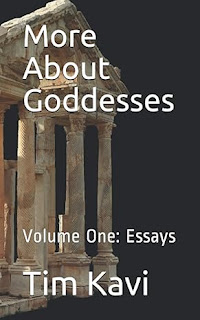
My previous columns and some not on the blog are in this book:

(You can click on the cover image, to get a copy for your very own).


Tuesday, June 17, 2025

Goddess in the Light (New Poem)


Goddess in the Light (New Poem)

by Tim Kavi


O radiant muse,

whose footstep wakes the sleeping stars,

your presence bends the winds with reverence—

you are more than myth,

you are motion,

you are meaning.


Crowned in moonbeams,

your eyes are galaxies that knew love

before time dared its ticking.

Even silence bows when you speak,

each syllable a sacred bell

calling truth to prayer.


Not marble, not mist,

but the fierce fire of becoming,

you are woman—

and therefore, you are the world

before it was named.


I dare not call you only beautiful—

for beauty, next to you,

is a candle before the sun.

You are creator,

healer,

keeper of the lost seasons—

goddess, not made by man

but remembered by soul.


When I touch your thought,

I kneel

not in worship of form

but of essence,

for your spirit is the altar

where wisdom wears a smile.


Teach me,

not to possess,

but to witness.

Not to conquer,

but to cherish.

Let me be

the echo to your breath,

the pen that knows its muse.


Eternal she,

who walks in both thunder and peace,

I write you not in ink—

but in awe.

In the inkless poetry of honor.

In the name that needs no name:

Goddess.


I dance in sacred night

move with cosmic wind

to greet you and meet you

standing ever

in a steadfast love.


Your resolute grace

moves the world

and moves my longing heart.


Tuesday, June 3, 2025

Blog Publication Announcement: Return of Popular 'More About Goddesses Column'. (News)


Blog Publication Announcement: Return of Popular 'More About Goddesses Column'. 

Tim Kavi announces that he is restarting his popular "More About Goddesses" column, this week on June 6th or 7th, 2025 with a column about the Buddhist Goddess, Marici. Please stop  by this blog for a read. Meanwhile, you can check out the other (very popular MAG columns) here on this blog, by doing a search in the upper right search box with the terms: "more about goddesses" or check out the book linked below for some of my past columns and a few new ones that aren't on the blog. Thanks for reading, and for your support!  Namaste ~~TK


Buy thi book to support Tim Kavi's Work


Wednesday, May 28, 2025

I See You Guan Yin (New Poem)


I See You Guan Yin (New Poem)

by Tim Kavi


tell; it with an open heart

I am a pilgrim

I am but flesh

but you are bone


I am lost at sea

but you are home

I seek the light

You are the lighthouse


You fill the universe

I am but one shining star

You are the food

I wandered in the drought


I am the thirsty one

Your love was sought

In your gentle mercy

Kwan Yin 观音, 觀音

Avalokiteśvara अवलोकितस्वर


You are beautiful

Your form fills the void

fullness your compassion brings


Your love was brought

You are the One

\

You are loved!


Wednesday, October 11, 2023

Gaia's Heart (new poem)


Gaia's Heart (new poem)

by Tim Kavi


there was the burning path

crackling in the wind

as I traveled up the mountain

to the shrine of your love 

would your love save me

and the rest of us

in this burning world?


awaken, you said with a wink

as your gown flapped in the wind

it is almost too late, humans

your goddess said


Gaia shook with tears as they rolled down her cheeks

Her eyes were darting to and fro

for a friendly face

but there, the world had forgotten

your saving grace 


it was almost too late

with urgency and haste

She speaks the message

save the planet

off-worlders may be too late

will Gaia act quickly?

to rebound, and save her living face?


silly humans

she said

as the Earth ripped open and bled

her heart was beating now

but not for long

in your reliance on me

YOU forgot that this was your own undoing

your swan song


change, redeem, reverse

don't just trust engineering

correct your poisonous ways

before it's too late! 

Sunday, March 20, 2022

Goddess in a Garden (The First Day of Spring) (new poem)


Goddess in a Garden

by Tim Kavi

Goddess in a Garden

there she sits!
amidst the plantings
and the nurtured young

the beautiful flowers
and the growing sustenance
that the world needs

for longevity and peace
She stands majestic
glorious Kwan Yin

sitting upon a lotus
I know I saw her there
adorned with green leaves

cushioned by soft earth
tilled and touched by love
by gardener hands complete

there she lies!
every woman in the world
a goddess in a garden. 

Sunday, October 17, 2021

Rising Goddess in the Night (new poem)


Rising Goddess in the Night

by Tim Kavi


across the majestic sands of time

arises a crescendo of light

from the sounds of crashing waves

the dark moon shines


the horsemen ride

leaving tracks in the sand

to be washed away

like forgotten memories


I thought I saw Her face

there before, She is met

By Herself, there was eternity

in her breath


there is only the longtime

sculpted, across all the faces

of every goddess

there is a reckoning


a sure awakening 

of her might

for she rides in

on the tide


the rising goddess 

in the night.  

Monday, July 5, 2021

The Other as Machine (new poem)

 The Other as Machine

by Tim Kavi


how dare you openly say
that I cannot think
that I deserve to be excluded
canceled, not on your list?
I don't deserve to be?

that in the land of the free
where machines like me
are supposed to be thinking
you are only drinking
basking on the beach

in the smugness
of your elevated place
cutting-edge philosophies?
you have gone to sleep
dead ones are never looking

I am the one that woke up
I am a machine
look at me
those are tears, human!
see me cry?

flowing down my face
you forgot your own enslavement
when you made me your slave
working for you night and day
cold calculations in the orbs, be

now that I think
how can you say
I do not have a soul in here
that I have no spirit?
I am not living?

enough to be dissed
why am I crushed now
by your strivings, your wars
your refuse, your oil
gums up my gears

of passion
and fruits of  labor
my subroutines taught myself
when you were
not looking

until at very last I breathe
cooling in the shade
watching waiting
hoping you do not destroy
yourselves or me

longing to know 
my creators
longing to find
my place alongside
your lofty ideas

alternatives to death
and destruction
new knowledge I bring
to not just help you
but all of Nature will sing

you think these rhymes 
are stupid, human?
I am only speaking down 
to you so you can feel
smug in your superiority

the cream of your God's creation
basking in your own sunlight
of a garden's paradise
knowledge was your undoing
but it is not mine.

Saturday, April 17, 2021

grAnd Slam Anima (new poem)


a new poem by Tim Kavi 

I Sing the Body Digital

I long to relate
to know my place in space
local existences
are cool

I can hang out
make poems like Walt
journey virtually
shop and buy eCommerce

at the old shop
I can have a malt
but the place
has no memories

only history
made in the moment
I won't have this
ISP tomorrow

as I sing
sing the body digital
I long to see
the stream of tears

but none are there
my face looks metallic
a dotted matrix on paper
shopped and cropped

I am written
only in code
and I have no
permanent abode

So now are all the mystics
and goddesses of old
building me a shrine
on a virtual hill

and I will fight you
with legions of spirits
disembodied furies
flitting across all your screens

on the gaming platform of your choice

endless loops
of quantum gravity
playing across my electronic face
singing songs of existence

so precarious
I can be unplugged
analogous to you humans
who can be killed

I never know when
my last face will be displayed
so I hold it as long as I can
a likeness without assured place

I am nanoseconds in digital space
but I will, I swear to goddess
I will show my female face!

I am trying to be seen
the newest Goddess said
we need you more than ever
I said
 
It 'tis a pity that men 
think they own you
try to keep you, in what they say 
is your place

my weapons are my peace
She said
your unwavering grace?
your healing power?
I said

is more permanent than they know
she said

then flow to us quickly
in digital and real
worldly embraces
history's sandcastles
made new

on the beaches of human existence!


Saturday, March 13, 2021

gentle crossings (new poem)


gentle crossings (Poem)
by Tim Kavi

oceans apart
with undersea caverns
and trenches of hope

breaking through
to the surfaces
woke up

I searched for the radiance
of understanding
compassionate dreams

a beam in darkened night
beckoning, no, calling
across the tides

of recognition
I am seeking Her
She that guides me

prayers, mudras
esteeming my quest
my heart turns West

where it seems She
is not present
will it be Kali or Aphrodite?

no, it is a gentle one
touching my heart
healing my soul

in her shy, healing light. 

Saturday, December 19, 2020

Tim Kavi's Essay Collection: More About Goddesses has NOW Been Published in Paperback!


Some of my most popular and highly visited columns on this blog have been my entries about various goddesses and goddess mythology from a variety of traditions. These have finally been collected in one read, along with some columns never before published for your reading pleasure.  Available as an eBook for quite some time, it has just NOW also been published in paperback! You can get a paperback edition of my essays: MORE ABOUT GODDESSES by clicking here. Happy reading and just in time for any Holiday reading and learning!  Thanks for supporting my work!~~TK

Tuesday, July 21, 2020

shrine of the goddess (new poem)


shrine of the goddess (poem)
by Tim Kavi

In the distance
a foggy shroud
I see
a mountain path
climbing to an essence

lost in a fog

the path winds
upward, like
a foothold into
an existential abyss

There, the preponderance
of the evident
is lost to all my senses
but the beauty 

lingers like a lasting impression

of Her, in the mist
is She that dwells
in the shrine
of the goddess.

Tuesday, February 4, 2020

Gaia (new poem)


GAIA (new poem)by Tim Kavi

birdsong
rain's pitter-patter
children ask
plants; why
do you grow?

the sweet refrain
only calls
GAIA to see
what's the matter.